

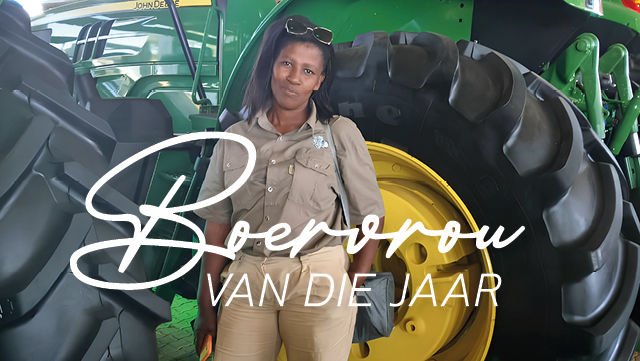
She wants to be remembered as a woman who fought for a better life through agriculture.
Katlego Kubedi, who has just been announced as the winner of the Bayer Boervrou van die Jaar 2025 competition in the female farmer category, says she hopes to be remembered as someone who planted seeds of change, who farmed with heart, uplifted others, and left behind a legacy of growth.
Katlego, a strong single mother, says she didn’t choose farming; it chose her. Her journey with farming began in Makouspan in Mahikeng, North West, where she started with poultry in a small backyard garden.
Over time, Katlego expanded into crop and livestock farming. Today, her family-run farm is committed to sustainable practices and uplifting the community. They supply produce to students at the North-West University, Mafikeng Nursing College, Taletso College, as well as tuck shops, catering companies, and more.
With limited resources, she transformed her farm into a place of growth, learning, and generosity – feeding families, mentoring young farmers, and setting an inspiring example for women in farming.
For Katlego, farming is a partnership with nature. She believes it demands patience, respect and a constant willingness to learn. She is resilient, driven by purpose and grounded in her values. Her family and faith keep her going and working with soil and animals brings Katlego closer to God.
Katlego’s journey
I was raised in North West, in a small rural village called Khunwana. Later, my family relocated to Bethel Village. I began my education at Khunwana Primary School, continued at Itlotleng Secondary School, and completed high school at Magongwane. After moving to Bethel, I finished Standard 9 and completed my matric at ZM Seatlholo, located in Lotlhakane, a village near Bethel. Shortly after matric, I got married and moved to Makouspan in search of better opportunities. That’s where my farming journey began, starting with poultry and a small backyard garden. I was married for 18 years and blessed with four children: two boys and two girls. After my divorce, I moved to Mandela Park Village and, without any tertiary education, turned my focus fully on farming to support my children. I enrolled in short courses and learnerships offered by Mahikeng’s local agricultural office, Lima Rural Development Foundation, Grain SA, and the Small Enterprise Development and Finance Agency (SEDFA), gaining valuable knowledge and experience. Eventually, I expanded into mixed farming, growing grain crops, raising poultry, and keeping livestock.
How farming found her
I didn’t choose farming; farming chose me. It runs in my blood and lives on through my children. I became a young mother, married early, and found myself stuck in routine chores. After my divorce, I was unemployed, had no qualifications, and struggled with hearing loss. But I had faith in God and remembered the hobbies that once kept me busy raising broilers and tending my garden. I knew I could start again, earn a living, and provide for my children.
Building the farm
Our farm is based in Mandela Park Village. I started on communal land with a modest chicken coop and a vegetable garden under one hectare. With no borehole, I relied on rainwater and fetched water from neighbours using a wheelbarrow. Initially, I focused on broiler chickens and sold them at government grant pay points, on the streets, and to nearby communities. I began with just 20 broilers and pumpkin in my garden. Over time, I expanded into crop farming and large livestock.
Describe a typical day on the farm
My day begins before sunrise with a walk through the fields. I check crops, feed the animals and meet with my team to plan the day. Afternoons are for admin work, training, and mentoring youth interested in farming. Evenings are family time, often spent discussing farm matters, as my children are passionate about agriculture and eager to learn. I cherish early mornings on the farm when mist covers the land, the fresh air blows, and everything feels possible.
Challenges as a farmer
My biggest challenges include unpredictable weather, limited access to funding, and navigating male-dominated spaces in agriculture. At times, it’s overwhelming, but I can’t walk away from something I love, something that gives me purpose and puts food on the table. Every challenge is a lesson and an opportunity to grow stronger.
What inspires you?
I’m inspired by the results of my hard work. I’m proud to be a self-taught farmer, learning from others, books, and daily experiences. I’ll never forget the joy of raising my first twenty chicks. If I could do that with no experience, imagine what’s possible. Contributing to South Africa’s food security brings me joy.
Words of encouragement
Believe in your strength. Don’t wait for permission to lead. Learn, ask questions, and build a support network. Success is not just about harvests. It is about impact.
Giving back
I mentor youth, host agricultural workshops, and advocate for inclusive farming policies. I aim to bridge tradition with innovation, turning rural dreams into real opportunities.
Community projects
I run small projects to teach youth agricultural skills. I donate produce to schools, crèches, churches and funerals. I use farm earnings to buy school shoes for children and participate in career days to promote agricultural careers. I also guide youth on applying for agricultural colleges, funding, learnerships, and internships. Each year, I host one intern on my farm to gain hands-on experience.
Legacy
I started with nothing but faith and the grace of God. If I could make it, so could others.